Choosing the right kitchen layout is one of the most foundational design decisions in any renovation or new build. Your layout affects how you move, cook, and live in your space — influencing workflow, sightlines, storage, and how comfortably multiple people can use the kitchen at once.
In this post, we’ll explore six of the most common kitchen layouts, their advantages, challenges, and which homes they work best in — so you can make a confident, informed choice for your next project.
Why Layout Matters
A great kitchen isn’t just about cabinetry style or finishes — it’s about how your space functions day to day. The “kitchen triangle” (sink, stove, fridge) and key zones (prep, cooking, storage) should flow intuitively.
Before deciding on a layout, consider:
- Available square footage and room shape
- How many people cook or use the kitchen simultaneously
- Adjacencies to dining, pantry, or living areas
- Storage needs and appliance sizes
- Desired openness and sightlines
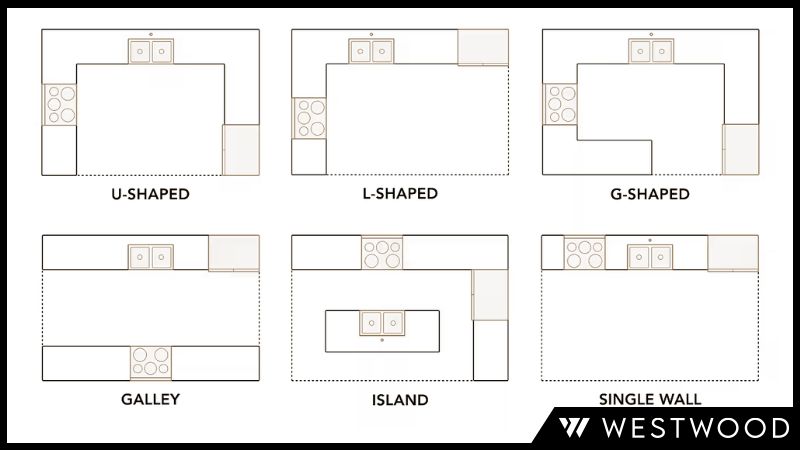
The Six Most Common Kitchen Layouts
1. U-Shaped Kitchen
What it is: Cabinets and counters run along three walls, forming a “U.”
Pros:
- Excellent storage and counter space
- Clear separation of work zones
- Efficient workflow and triangle layout
Challenges:
- Can feel enclosed in narrow rooms
- Requires careful appliance spacing
Best for: Mid- to large-size kitchens with enough floor space to move comfortably.
2. L-Shaped Kitchen
What it is: Cabinets and counters along two adjoining walls, forming an “L.”
Pros:
- Open and flexible — integrates beautifully with adjoining spaces
- Great flow and visibility
- Allows for island addition in many cases
Challenges:
- Long legs can increase walking distance between zones
- Slightly less storage than U- or G-shapes
Best for: Open-concept homes or moderately sized kitchens seeking a light, airy feel.
3. G-Shaped Kitchen
What it is: Similar to a U-shape, but with a partial “peninsula” or fourth leg that forms a “G.”
Pros:
- Extra counter and storage space
- Natural separation between kitchen and living areas
- Perfect for adding peninsula seating
Challenges:
- Risk of tight walkways
- Not suited for compact spaces
Best for: Larger homes wanting semi-enclosed function with added storage.
4. Galley Kitchen
What it is: Two runs of cabinetry facing each other with a walkway in between.
Pros:
- Extremely efficient in narrow layouts
- Keeps all key zones within easy reach
- Great for condos or smaller homes
Challenges:
- Limited space for multiple cooks
- No room for an island
Best for: Apartments, townhomes, or small spaces where width is limited but length is available.
5. Island Kitchen
What it is: Any layout that includes a freestanding island, often combined with L- or U-shapes.
Pros:
- Adds prep space, seating, and storage
- Creates a central hub for gathering
- Visually defines an open-concept floor plan
Challenges:
- Requires clearance around all sides
- Higher cost if plumbing or appliances are added
Best for: Homes with at least 12 feet of width or open layouts ideal for entertaining.
6. Single Wall Kitchen
What it is: All cabinetry and appliances positioned along one wall.
Pros:
- Highly space-efficient
- Minimal, modern aesthetic
- Cost-effective design and installation
Challenges:
- Limited storage and prep space
- Longer walks between zones
Best for: Studios, small apartments, or secondary suites.
How to Pick the Right Layout for Your Home
Your Home / Use Case: Narrow or small space
Recommended Layout(s): Galley, Single Wall
Why: Most compact and efficient
Your Home / Use Case: Open concept living
Recommended Layout(s): L-shape + Island, U-shape
Why: Offers flexibility and smooth flow
Your Home / Use Case: Maximum storage & function
Recommended Layout(s): U-shape, G-shape
Why: Provides ample cabinetry and pantry options
Your Home / Use Case: Entertaining & social cooking
Recommended Layout(s): Island layout
Why: Island becomes the focal hub for gathering
Your Home / Use Case: Dividing zones subtly
Recommended Layout(s): G-shape, U-shape with peninsula
Why: Helps define the kitchen while keeping it connected to living areas
Ask yourself:
- How many people use the kitchen daily?
- Do you need seating at an island or peninsula?
- Are sightlines and openness a priority?
- What appliances or special features are must-haves?
- Do you prefer a hidden or display-oriented layout?
Visualizing Your Space
Before finalizing your plan:
- Sketch your kitchen triangle (sink, stove, fridge) and test walking distances.
- Mark pathways on your floor plan to ensure clearance.
- Tape off dimensions in your actual space.
- Visit showrooms or model homes for real-world examples.
- Consult with a professional designer — layout insights can save costly reworks later.
At Westwood Cabinetry, we know every kitchen layout should reflect your home’s architecture, your lifestyle, and your needs. Once your layout is chosen, our design team will help you pair it with cabinetry styles, finishes, and storage features that make the most of your space — and your everyday routine.