Walk into most kitchens and your eye goes straight to the cooking wall. If the range hood is a stainless box floating on its own, that wall can feel unfinished. A custom range hood changes that. It turns a necessary appliance into the centrepiece of the room.
Here’s how our designers approach custom hoods, from style choices to the practical details that keep them working well.
What Is a Custom Range Hood?
A custom range hood is a decorative cover built around a hood insert (the fan and filters that do the work). The insert handles ventilation, and the cover is cabinetry designed to match or contrast with your kitchen. That means you get the performance of a proper fan with a look that belongs in your home.
Custom Range Hood Styles
Matching the cabinetry
A hood in the same finish as your uppers creates a calm, built-in look. In Shorerise by Dilworth Homes, the custom hood shares the uppers’ Vanilla Milkshake lacquer, so the cooking wall reads as one clean piece.
A contrasting accent
Use the hood to repeat your island colour or bring in a new one. In the Modern Farmhouse kitchen on Russo Street, the custom hood fan is finished in Chantilly Lace against a Steel Wool perimeter.
Curved and sculptural
A curved hood softens a kitchen full of straight lines. The Elegant Homburg Haven kitchen by Allison Braun features a sculptural curved hood in Homburg Grey, with Greystone trim and matching floating shelves.
Warm wood
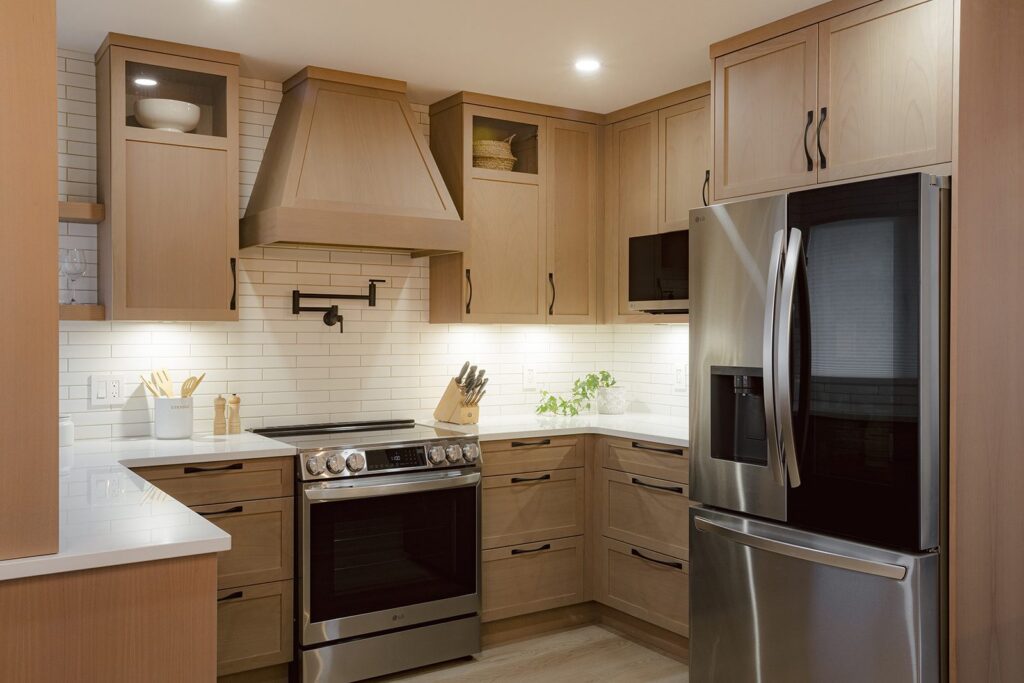
A wood hood brings natural texture to the cooking wall. Built from the same wood as the cabinets, it makes even a compact kitchen feel warm and pulled together. In Sweet Moments, a kitchen renovation designed by Christine Caracciolo, the tapered custom hood fan is built from maple to match the shaker cabinets. Glass-top uppers on each side and a pot filler above the range complete the cooking wall.
Planning the Space Around Your Hood
A custom range hood is a design feature, but it starts with practical decisions.
- Choose the insert first. The size and power of the fan should suit your range. Your appliance supplier can recommend the right one.
- Plan the venting route. Ducting needs a clear path to the outside. This is easier to solve at the design stage than after cabinets are built.
- Check clearances. Follow the hood and range manufacturers’ requirements for mounting height and clearances.
- Ask about make-up air. Some powerful hoods require a make-up air system under local building codes. Your contractor will know what applies.
- Use the sides. Spice pull-outs or narrow cabinets beside the hood keep oils and spices right where you cook.
Frame the Cooking Wall
The cabinets around the hood matter as much as the hood itself. Symmetry helps: matching uppers, glass-front cabinets or floating shelves on each side frame the hood and make it the focal point. Running the hood to the ceiling, or lining it up with the top of your stacked uppers, gives the wall a finished, architectural look.
Designer Tip: Bring the exact model of your hood insert to your design meeting. Custom hood covers are built around the insert’s dimensions and duct location, and having it early prevents changes once production starts.
Design a Hood That Pulls the Kitchen Together
A custom range hood is one of the few features that is both hard-working and purely beautiful. Our designers can help you choose a style, plan the venting and build the cabinetry around it so the whole cooking wall feels complete.
Visit our Kelowna showroom or book a free consultation to start designing.