
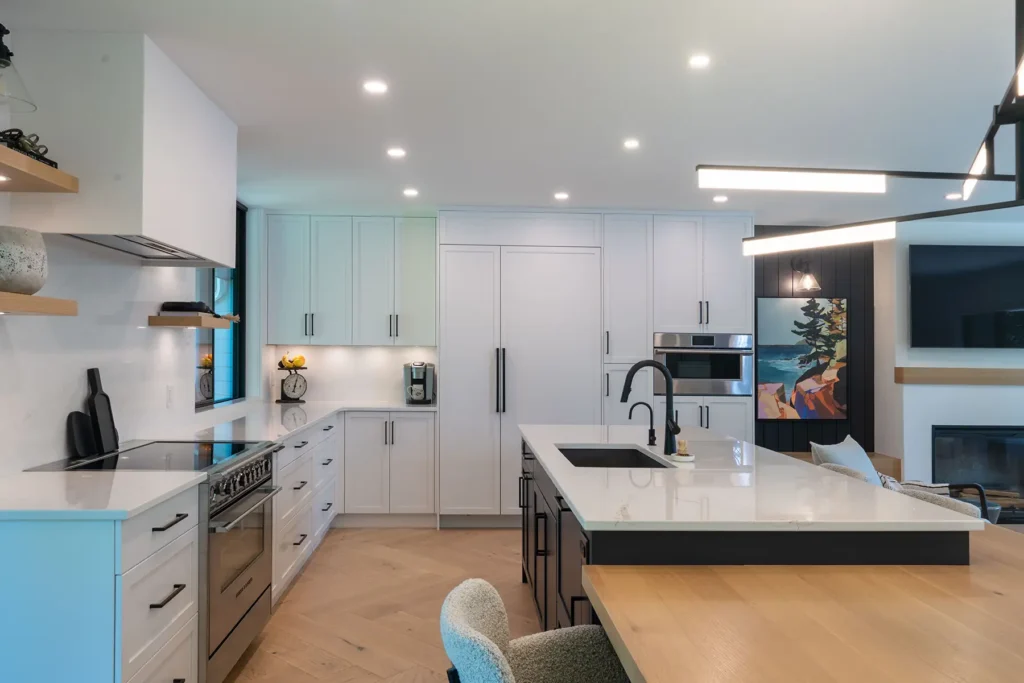
You’ve chosen a door style you love, a finish you’ve looked at a hundred times, and hardware that feels just right. Then a big stainless fridge lands in the middle of it all, and suddenly that’s what everyone sees.
Integrated appliance panels fix that. They cover your fridge, dishwasher or beverage fridge with cabinetry that matches the rest of the kitchen, so the room reads as one calm, built-in design. Here’s how our designers plan them.
What Are Integrated Appliance Panels?
Integrated appliance panels are cabinet doors made to fit the front of a panel-ready appliance. They use the same door style, material and finish as the cabinets around them, and the same hardware. Once installed, a fridge can look like a pantry cabinet and a dishwasher like a run of drawers.
The appliance works exactly the same. The difference is all in the cabinetry.
Where Integrated Appliance Panels Make the Biggest Difference
The fridge wall
The fridge is the largest appliance in most kitchens, so paneling it has the biggest effect. In Hall Road, designer Kati Knorr paneled the fridge in the same Chantilly Lace shaker doors as the perimeter, with long matte black pulls that match the rest of the hardware. A tall cabinet with a built-in wall oven sits beside it, so the whole wall reads as one piece of cabinetry.
The island
A dishwasher on the island often faces the living room. A matching panel keeps the island looking like furniture instead of a work zone.
The bar or coffee station
A beverage fridge framed in cabinetry makes a bar feel custom. In Rift Cut Reflections, Kati framed the beverage fridge in the same Tudor-stained rift cut white oak as the bar cabinets.
Freezer and fridge drawers
Drawers in a snack station or butler’s pantry disappear completely behind matching drawer fronts.
How Integrated Appliance Panels Are Designed
Great panels take more than a matching colour.
- Same door style. A shaker kitchen gets shaker panels; a slab kitchen gets slab panels.
- Same finish and grain. In wood kitchens, your designer can plan grain direction so panels flow with the doors next to them.
- Matching reveals. The gaps between panels and doors should line up with the rest of the kitchen.
- Consistent hardware. Use the same pulls, sized for the panel. Tall appliance pulls in the same finish keep everything consistent.
- Balanced proportions. Panels should line up with the cabinets beside them, top and bottom.
Custom-Fit Appliance Boxes
The cabinetry around an integrated appliance matters as much as the panel. Appliance boxes are the cabinets built around the appliance, sized to its exact model so the fit is tight and the panel sits flush.
Custom-fit appliance boxes are part of our Custom series, where every cabinet is made to order and built to your exact dimensions. Your designer will size each box around your appliance’s installation specs, so the panel sits flush with the doors beside it.
Plan the Wall, Not Just the Appliance
An integrated fridge looks best when it’s part of a bigger design.
- Flank it with tall cabinets. Pantry or wall oven cabinets on each side frame the fridge and make it disappear.
- Run it to the ceiling. A cabinet above the fridge, finished to the ceiling, completes the built-in look.
- Keep the tops in line. Panel tops should match the tall cabinets beside them.
Designer Tip: Choose your appliance models before your cabinet design is finalized, and bring the installation specs to your design meeting. Panel sizes, weights and hinge requirements vary by model, and your cabinetry is built around those exact numbers.
Design a Kitchen That Looks Built-In
Integrated appliance panels are one of the details that make a kitchen feel truly custom. Our designers can plan the panels, the cabinets around them and the hardware so everything reads as one complete design.
Visit our Kelowna showroom or book a free consultation to get started.


